




























_branded-1024-q70.webp)


















The Workflow Company are true GTM experts, both technical and reliable while fully understanding business goals. They built a Google Maps-based solution that gives us complete prospect lists in minutes and confidence we never miss key accounts. Their systematic approach enabled our nationwide expansion. Highly recommended.


In the fast-paced, venture-backed business environment, it’s usually time—not money—that becomes the biggest constraint to progress.
What sets Joe apart is his proficiency in translating strategy into actionable steps, effectively streamlining the process and saving invaluable time in the startup journey.


Joe was incredible to work with. You will not find anyone more thorough and thoughtful with their work. We were able to accomplish all of our RevOps/GTM initiatives in a short period of time thanks to how quickly Joe and the team can get shit done.
Would highly recommend!


The Workflow Company and Joe are true partners in GTM. They are very thoughtful, will deeply understand your ICP and requirements like an internal member of the team. Joe was a GTM Engineer before that role existed, he is highly technical and creative.
I would highly recommend.


What sets Joe apart is his unique blend of startup operational experience and technical savvy. He is able to audit your startup's operations and implement an automation strategy that fits your current needs and future goals.


Joe's extensive startup experience means he really understands startup dynamics and necessities. What stood out was his way of solving problems. He was able to come into a messy data set-up, typical of a startup that has shifted directions a few times, and quickly get a deep understanding without significant engineering hand-holding.








We offer two models depending on how you want to own and maintain the infrastructure:
Managed Infrastructure (Custom Code)
We build robust, code-based systems and maintain them on your behalf. You pay for usage plus ongoing maintenance, and we handle updates, improvements, and fixes. This model works well for teams who want maximum reliability and continuous evolution without building internal technical capacity.
The advantage is that you get software engineering best practices - version control, observability, proper error handling - without needing to manage it. We keep improving the system as your needs evolve.
Client-Owned Infrastructure (Low-Code)
We build in low-code platforms like N8N or Clay, then hand off ownership to your team with full documentation. We use GitHub for documentation and Loom walkthroughs where needed. Your team maintains and evolves the system going forward.
This model works well for teams who want to build internal capacity and have more direct control over their workflows. Most changes are straightforward to implement yourself after the training we provide.
We'll recommend the right model during our discovery conversation based on your team's capacity and preferences.
This is a true collaboration, not us showing up with a pre-built playbook.
You bring the business expertise. You know your market, your customers, and what moves the needle for your specific business. You have the instincts about which GTM motions would 10x your growth if you could just execute them consistently. That domain knowledge and taste has to come from you.
We bring the AI GTM systems expertise. We've built these systems across multiple clients, so we know what works technically and architecturally. We think in systems - how to design something robust, scalable, and maintainable. We translate your ideas into infrastructure that actually runs.
The best outcomes come from teams who are engaged partners, not passive clients waiting for a deliverable. We're not here to dictate what you should build - we're here to take whatever ideas you have and make them real.
Not sophisticated, but defined. There's an important difference.
We work best with teams who have been running their GTM processes manually for a while and have a clear sense of what works. You don't need fancy tools or complex systems - you just need to know what you're trying to do.
The honest truth is that automation amplifies whatever you already have. If your process is solid, automation makes it faster and more consistent. If your process is still being figured out, automation just makes the mistakes happen faster.
If you're still in experimentation mode, we might recommend starting with a more embedded resource who can iterate with you in the trenches. Once your processes are stable, that's when automation ROI really kicks in.
Probably not, honestly.
We're not optimized for quick, one-off projects like "migrate our data to a new CRM by Friday" or "set up an outbound campaign this week." There are excellent freelancers and agencies who specialize in fast turnarounds for those needs.
Where we focus is building robust foundations - systems designed to scale and last. That requires more upfront investment in architecture and thoughtfulness, which doesn't make sense for simple, urgent projects.
If you want something done fast with less emphasis on long-term scalability, we can recommend providers who are great at that. If you want to build something once and have it work reliably for years, that's where we come in.
We work best with Series A to Series D companies that have some traction and defined GTM processes to automate.
Pre-seed and seed-stage companies are often still figuring out their go-to-market motion - which means the processes we'd automate might change significantly in a few months. That's not a great fit for our approach.
If you're early stage, our honest recommendation is to keep running things manually until you have clear patterns that are working. Once you're doing the same things repeatedly and they're clearly valuable, that's when automation ROI kicks in.
That said, if you're early stage with more ironed-out GTM processes or looking to build a strong initial foundation that allows for quick iterations and experimentation, we're happy to have a conversation.
Our engagements typically fall in the five to six figure range, depending on scope and complexity.
We're not the right fit for budgets in the low four figures. If you're looking for a quick, low-cost solution, we're happy to recommend other providers who specialize in that. Our work is priced for companies making a serious investment in GTM infrastructure - the kind that pays off over years, not weeks.
The exact investment depends on scope, complexity, and the engagement model you choose. We'll give you a clear proposal after our discovery conversation.
We're largely tool-agnostic and work with whatever's in your stack. Common platforms include:
CRMs: Attio, HubSpot, Salesforce
Data & Enrichment: Clay, LinkedIn Sales Navigator
Automation: Custom code, N8N
That said, we tend to skew towards tools that allow us to build robust systems grounded in software engineering best practices - things like version control, proper error handling, observability, and modular architecture. That naturally pulls us towards code-based solutions, though we use low-code tools like N8N when client-owned infrastructure makes more sense.
The specific tools matter less than the architecture. We build systems that can adapt as your stack evolves - so if you switch CRMs or add new data sources, the underlying logic doesn't break.
Most engagements run about three months total, but you'll see working systems much sooner than that.
We take a phased approach and prioritize time-to-value. First deployments typically happen within the first month - we want you seeing real results early, not waiting until everything is "done." Three months is about how long it takes to build the full system because most projects involve interconnected pieces (like laying foundations before activation layers) and require iteration as we catch edge cases and dial things in.
We're not optimized for quick one-week projects. If you need something done fast with less emphasis on long-term scalability, there are great freelancers and agencies who specialize in that. We focus on building foundations that last - but we ship often along the way.
Every engagement follows a similar arc: Discovery, Build, and Iterate.
Discovery (Week 1-2): We map your current processes, interview key stakeholders, identify bottlenecks, and align on priorities. This is where we figure out what to build and why.
Build (Weeks 2-8): We architect and implement the systems. You'll see working versions early and often - we don't disappear for weeks and come back with a finished product.
Iterate (Ongoing): Based on real usage and feedback, we refine and optimize. This is where the system gets dialed in to your specific needs.
What happens after depends on the engagement model - see "What are the different engagement models?" for details on managed vs. client-owned infrastructure.
That's completely normal. Most teams come to us knowing they want to use AI to improve their GTM, but aren't sure where it will have the biggest impact.
We start every engagement with a discovery phase where we map your current workflows and identify where AI can create real competitive advantage - not just saving time, but unlocking GTM motions that would be impossible otherwise. The most valuable opportunities are usually where you have unique data, insights, or perspectives that AI can operationalize at scale.
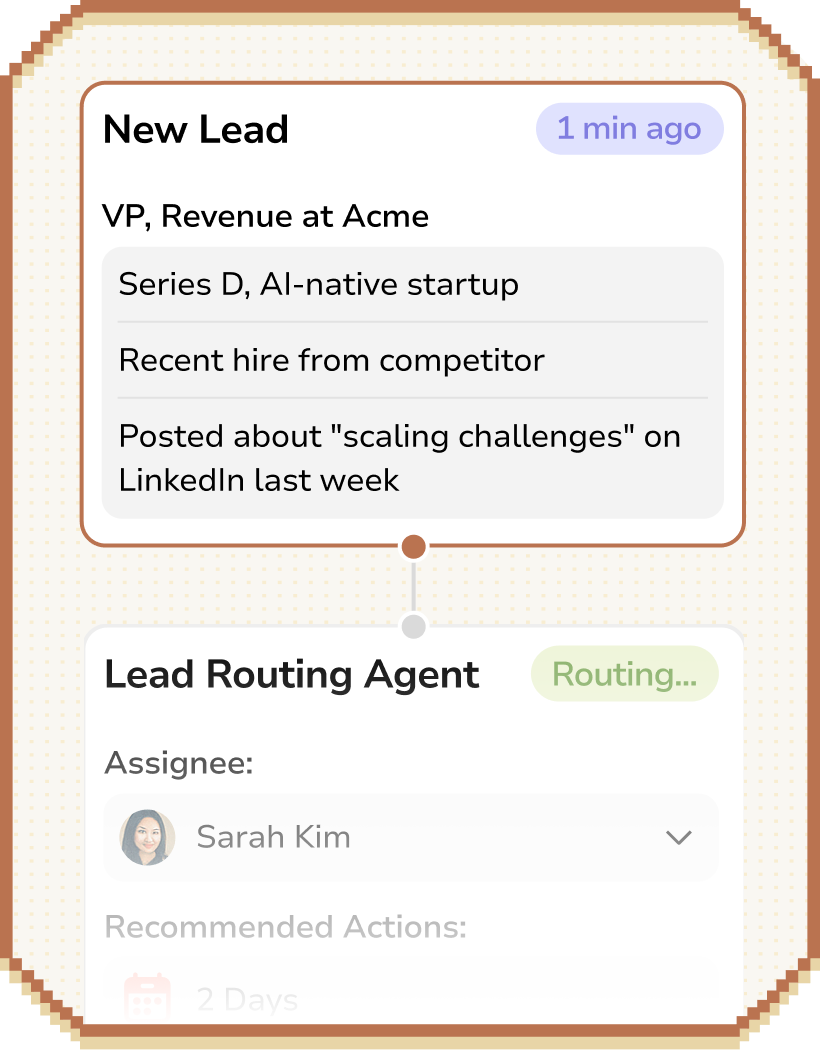
This often includes automating repetitive work - freeing your team to focus on the more creative, strategic, human side of GTM. But beyond efficiency, we're looking for opportunities to build systems that let you do things your competitors simply can't copy - like personalizing outreach based on signals only you have access to, or routing leads using scoring models trained on your specific win patterns.
We work best with teams who have a solid grasp of their GTM - what's working, what isn't, and strong hypotheses about what could work even better. You don't need every step mapped out, but you've developed the instincts and taste through experience that we can amplify with AI. If you're still early in understanding which GTM motions work for your business, it might be too soon.
This is one of our core design principles. We build systems with the assumption that external APIs change, data sources shift, and edge cases appear.
Every workflow we build includes error handling, logging, and alerts so you know immediately when something needs attention. We also write documentation for your team so they understand how things work.
During our engagement, we handle all maintenance and fixes. What happens after depends on your engagement model:
Managed infrastructure: We continue handling maintenance, fixes, and improvements as part of your ongoing arrangement
Client-owned infrastructure: Your team handles day-to-day updates using the documentation and training we provided. We're available for questions or more complex changes if needed.
We'll set clear expectations about post-engagement support during the initial scoping conversation.
You don't need any coding skills. We handle all the technical implementation.
What you do need is someone on your team who understands your GTM processes deeply and can make decisions about prioritization, edge cases, and what "good" looks like. This person will work closely with us during the engagement.
The main interface for your team will be your CRM. We build triggers, buttons, and enrichment flows that work within the tools your team already uses, so the day-to-day experience feels native to your existing workflow.
We specialize in B2B go-to-market operations across industries. Our clients include VC-backed startups in AI, fintech, HR tech, dev tools, and enterprise SaaS.
The specific industry matters less than the underlying GTM patterns. Most B2B companies need similar things: identifying the right accounts, enriching contact data, personalizing outreach, and routing leads efficiently. These patterns are remarkably consistent across industries.
What does matter is whether you have a solid grasp of your GTM - what's working, what you want to double down on, and some hypotheses about what AI could unlock for you. We're here to amplify and operationalize your vision, not to tell you what your GTM should look like.
Our philosophy is "human empowerment through AI" - we build systems that encode your team's judgment and expertise, then let AI execute at scale while keeping humans in control of what matters.
In practice, this means your best instincts and knowledge get baked into the system - through prompts, scoring logic, and decision rules - so the AI operates with your perspective, not generic automation. AI might research a prospect's company and draft personalized talking points based on criteria you've defined. But a human reviews and sends the actual message. AI might score and route inbound leads using patterns you've identified, but a human decides which ones to prioritize.
We've seen too many companies automate themselves into spam. Our approach is to use AI to make your team more effective, not to replace the authentic human connection that actually closes deals.
Yes, and this is a key part of our approach. We build everything with the expectation that requirements will change.
For client-owned infrastructure (N8N, Make, etc.): Your team can make modifications directly. We train you on how the workflows work, and most changes are straightforward to implement yourself using the documentation we provide.
For managed infrastructure (custom code): We handle modifications as part of your ongoing arrangement. You tell us what you need changed, and we implement it with proper testing and deployment.
During the engagement, we iterate constantly based on your feedback. The goal is to build systems that wrap around how you already work - accelerating your team rather than forcing them to learn new workflows. And of course, systems that can evolve as your needs change.
We're designed to be low-overhead. Most of our clients allocate 2-4 hours per week for a primary point of contact during active build phases.
That time is spent on decisions, not implementation. Things like: Which fields should we prioritize for enrichment? How should we score these leads? What does a "good" prospect look like for this campaign?
The heaviest lift is typically in the first few weeks when we're mapping your processes and making foundational decisions. Once systems are running, the time commitment drops significantly.
We explicitly don't want you to feel like you hired a contractor you have to manage. Our model is more like a partner who takes ownership of outcomes, not just tasks.